How Ocean-Going Vessels Respond to Mandatory Dynamic Speed Restriction Zones Aimed at Protecting Whales
Abstract
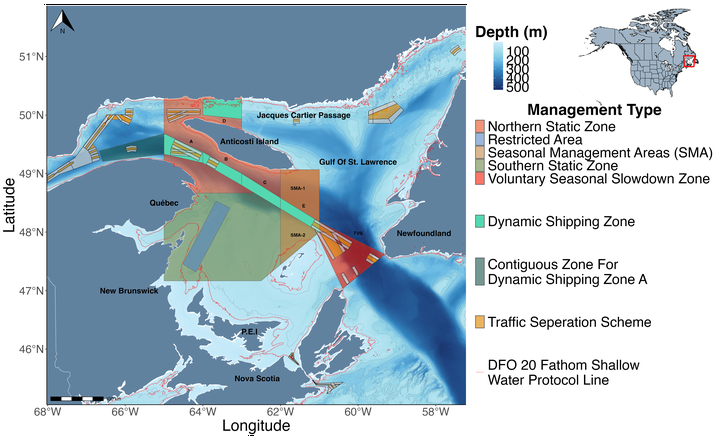
Dynamic vessel speed restrictions occur when at-risk whales are detected, while permitting normal operating speeds in the absence of detections. No studies have characterised how vessels respond in areas adjacent to speed-restricted zones. We examined ocean-going vessel speeds proximate to four contiguous Dynamic Shipping Zones (DSZs) when one or more were under 10-knot speed limits following North Atlantic right whale (NARW) detections. We analysed the speeds of 11,509 transits by tanker, cargo, and cruise ships across forty-nine active slowdown periods during the 2020–2023 NARW seasons. Ninety-six percent of vessels travelled at ≤ 10 knots in speed restriction zones (n = 3944). When vessels exceeded an active slowdown speed limit, the average speed was 10.54 ± 1.19 knots for all ships (n = 124), 10.56 ± 1.28 knots for cargo ships (n = 98) and 10.45 ± 0.63 knots for tankers (n = 26). Despite typically travelling at high speeds (15.10 ± 3.37 knots) no cruise ships transited > 10 knots during active slowdowns. Vessels in zones contiguous to DSZs with active slowdowns travelled ≤ 0.5 knots slower than when no active slowdowns were present, regardless of the number of contiguous zones under speed restrictions. Some (3.81%) vessels treated the DSZs as static areas, travelling < 10 knots throughout the NARW season, independently of verified whale presence. We found vessel speed changes were generally < 1 knot in contiguous and non-contiguous zones during time periods with active slowdowns. Though vessels occasionally exceeded the 10-knot speed limit, the average excess speed was small, and the management measures were successful at enforcing reduced vessel speeds with only minor compensations.